every day life
September 26, 2013
Mindfulness is the energy of being aware and awake to the present moment. It is the continuous practice of touching life deeply in every moment of daily life. To be mindful is to be truly alive and present with those around you and with what you are doing. We bring our body and mind into harmony while we wash the dishes, drive the car or take our morning cup of tea.
~ Thích Nhất Hạnh

some glad morning
September 16, 2013
It has been said that the highest wisdom lies in detachment, or, in the words of Chung-Tzu, ‘The perfect man employs his mind as a mirror; it grasps nothing; it refuses nothing; it receives, but does not keep.’
Detachment means to have neither regrets for the past nor fears for the future; to let life take its course without attempting to interfere with its movement and change, neither trying to prolong the stay of something pleasant nor to hasten the departure of things unpleasant.
To do this is to move in time with life, to be in perfect accord with its changing music, and this is called Enlightenment. In short, it is to be detached from both the past and future and to live in the eternal Now.
For in truth neither past nor future have any existence apart from this Now; by themselves they are illusions. Life exists only at this very moment, and in this moment it is infinite and eternal. For the present moment is infinitely small; before we can measure it, it has gone, and yet it persists for ever.
~ Alan Watts
eternal life
September 15, 2013
Aging gives us a chance to learn to use the shadows in our life as vehicles for our awakening — and the longest shadow of all is death.
How you relate to death is the key spiritual work of aging. And how you see death is a function of how much you identify with that which dies.
Egos die.
~ Ram Dass
comparative religions
September 2, 2013
If your understanding of the divine made you kinder, more empathetic, and impelled you to express sympathy in concrete acts of loving-kindness, this was good theology.
But if your notion of God made you unkind, belligerent, cruel, or self-righteous, or if it led you to kill in God’s name, it was bad theology.
~ Karen Armstrong, The Spiral Staircase: My Climb Out of Darkness
own your anger
August 20, 2013
Whenever the energy of anger comes up, we often want to express it to punish the person whom we believe to be the source of our suffering.
This is the habit energy in us.
When we suffer, we always blame the other person for having made us suffer. We do not realize that anger is, first of all, our business.
We are primarily responsible for our anger, but we believe very naively that if we can say something or do something to punish the other person, we will suffer less.
This kind of belief should be uprooted. Because whatever you do or say in a state of anger will only cause more damage in the relationship.
Instead, we should try not to do anything or say anything when we are angry.
~ Thich Nhat Hanh

freedom with each step
August 13, 2013
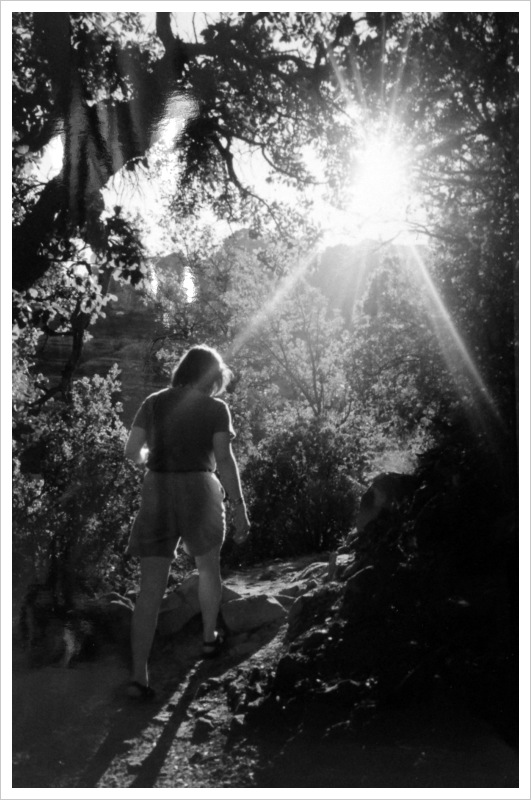
When you enjoy every step,
you walk as a free person on this earth.
Breathing in, you may walk two or three steps,
and you may feel, ‘I have arrived, I have arrived.’
I have arrived in the here and the now, where life is available.
I have arrived means, ‘I don’t want to run anymore.
I have run all my life; now it is time to lead my life properly,
so that every step brings me home, where I can touch life deeply…’
Breathing out you may make three or four steps,
and you may feel, ‘I am home, home, home.’
This is not a verbal declaration: it is a realization.
Every step brings you home to the present moment
where all the wonders of life are available and your body is available….
Walk in such a way that you are not looking
for something else in the future.
You are touching the Kingdom of God.
You are touching the Land of the Buddha
in the here and the now.
Walk as if you kiss Mother Earth with your foot.
Every step is healing.
Every step is a miracle.
~Thich Naht Hanh, Plum Village, France, 6/2/2012
fearless observation
August 9, 2013
See yourself in all that lives and your behaviour will express your vision. Once you realize that there is nothing in this world which you can call your own, you look at it from the outside, as you look at a play on the stage, or a picture on the screen, admiring and enjoying, but really unmoved.
As long as you imagine yourself to be something tangible and solid, a thing among things, actually existing in time and space, shortlived and vulnerable, naturally you will be anxious to survive and increase.
But when you know yourself as beyond space and time, in contact with them only at the point of here and now, otherwise all-pervading and all-containing, unapproachable, unassailable, invulnerable, you will be afraid no longer.
~ Nisargadatta Maharaj

no beliefs
August 7, 2013
The fundamental aim of Buddhist practice is not belief; it’s enlightenment, the awakening that takes place when illusion has been overcome.
It may sound simple, but it’s probably the most difficult thing of all to achieve. It isn’t some kind of magical reward that someone can give you or that a strong belief will enable you to acquire.
The true path to awakening is genuine discernment; it’s the very opposite of belief.
~ Trinlyay Tulku Rinpoche
introspect
August 4, 2013
When your mind is trained in self-discipline, even if you are surrounded by hostile forces, your peace of mind will hardly be disturbed. On the other hand, your mental peace and calm can easily be disrupted by your own negative thoughts and emotions. The real enemy is within, not outside.
~ The Dalai Lama
witness your anger
July 30, 2013
Many years ago, I walked into the kitchen of my guru’s ashram, and found him shouting at the cooks. Force- waves of anger were bouncing around the room, almost visible to the naked eye. Then, in mid sentence, he turned, saw us standing there, and smiled. The energy in his eyes went soft. ‘How did you like the show?” he asked. Then, chuckling, he slapped the head cook playfully on the back, and walked away. The cooks giggled, and went back to work, galvanized by the energy he had injected into the afternoon.
That moment changed my understanding about emotions. The clarity and fluidity with which he had shifted from intense anger to good humor was only part of it. More interesting, I felt, was the fact that he had been using anger as a teaching tool. Was he really angry? I don’t know. All I know is that he seemed able to ride the wave of his anger with perfect easiness, and let it pass without a trace.
One of the ideals of yogic freedom is detachment from emotions. It’s a basic axiom, in fact, that an advanced practitioner has perfected the ability to control, transcend, or at least be a disengaged witness of his emotions. Yet because we have so few models of what genuine detachment looks like, we tend to confuse yogic detachment with being buttoned up, or unemotional, or indifferent.
My teacher was modeling something quite different. As I saw it at the time, he was demonstrating a kind of freedom in emotions. This allowed him to work with emotional expression as an artist or an actor might work with a palette of feelings in order to inspire others, or induce a shift in the situation around him. The secret was that he was able to be conscious within the emotion.
Most people assume that a good spiritual practitioner never gets carried away by emotion — at least not by negative emotion. Yet the deeper truth is that spiritual practice will not eliminate negative emotions. Emotions are part of the palette of life, part of the way consciousness moves. Not only can’t you get rid of them, but you’d feel empty and impoverished if you did. Practice can change your relationship to emotions, so that instead of being swamped by certain feeling states, they can be fully experienced and expressed without resistance and judgement.
– Sally Kempton, in Using Emotions for Liberation