mirror mind
February 3, 2010
We assume that our mind automatically grasps reality but don’t know how artfully the mind works and, therefore, we live in delusion and suffering. The mind must be developed. The Buddhist teachings show how to liberate the mind from ignorance and obtain wisdom or insight. Wisdom implies a mind with equanimity, free of mental defilements, not influenced by worldly pleasures or suffering, a mind detached from the past and the future, a calm and collected mind that experiences that the reality of all phenomena is in its impermanence and selflessness.
– Lieu Phap, from “Land of Ten Thousand Lakes”

same as it ever was
January 31, 2010
At the heart of Christianity, which defines much of Western civilization, and Buddhism, a driving force in Eastern culture, lies the same basic wisdom. Both Jesus and Buddha focused on the individual, emphasizing that the inner person is more vital than the outer image, and that each of us needs to look at our own life rather than criticizing others. They use the same imagery of light and darkness, sun and rain, the fruitful and the barren in describing their moral world.
Contemporary scholars searching for the historical Jesus are placing increasing emphasis on his role as a first-century sage. Many of the aphorisms they cite in portraying him as a wisdom sayer embody the same advice that Buddha provided to his followers five hundred years earlier.
– Marcus Borg, from “Jesus & Buddha – The Parallel Sayings”
it comes and goes
January 29, 2010
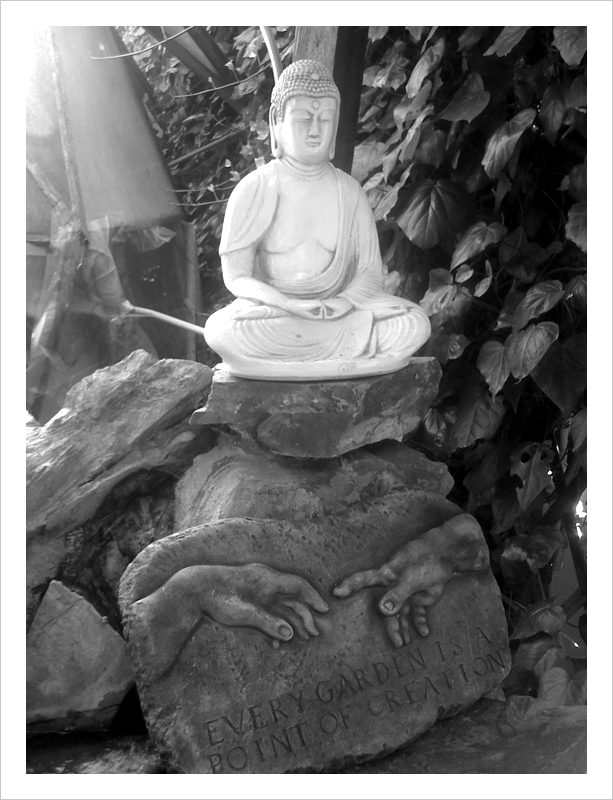
Consider the ebb and flow of the tide. When waves come to strike the shore, they crest and fall, creating a sound. Your breath should follow the same pattern, absorbing the entire universe in your belly with each inhalation. Know that we all have access to four treasures: the energy of the sun and moon, the breath of heaven, the breath of earth, and the ebb and flow of the tide.
– Morihei Ueshiba, from “The Art of Peace”

where you go is where you’ll be
January 29, 2010
Whether you turn to the right or to the left, your ears will hear a voice behind you, saying, “This is the way; walk in it.”
– Isaiah 30:21

loving the unlovable
January 25, 2010
Metta, or lovingkindness, is one of the most important Buddhist practices. Simply stated, metta is the heartfelt wish for the well-being of oneself and others. When describing metta, the Buddha used the analogy of the care a mother gives her only child. Lovingkindness is also understood as the innate friendliness of an open heart. Its close connection to friendship is reflected in its similarity to the Pali word for friend, mitta. However, metta is more than conventional friendship, for it includes being openhearted even toward one’s enemies, developed from insight into our shared humanity.
– Gil Fronsdal, from “Five Practices to Change Your Mind”

here and now
January 25, 2010
A monk was being chased by a tiger toward the edge of a cliff. He leaps off the cliff, grasping a vine that has grown over the edge. Below him is a long drop to a certain death, above him is the snarling tiger. As the monk swings in midair, a mouse begins gnawing at the vine above him. His position is one of utter precariousness. Growing out of the cliff in front of him is a wild strawberry, which he picks and eats. He says, “This strawberry is delicious.”
– Sylvia Boorstein, from “It’s Easier Than You Think”

wake up
January 23, 2010
How many people have provoked the question, “What are you? What order of being do you belong to? What species do you represent?” Not, “Who are you?” with respect to name, origin, or ancestry, but “What are you?” Not Caesar, certainly. Not Napoleon, or even Socrates.
Only two: Jesus and Buddha. When the people carried their puzzlement to the Buddha himself, the answer he gave provided an identity for his entire message.
“Are you a god?” they asked. “No.” “An angel?” “No.” “A saint?” “No.” “Then what are you?”
Buddha answered, “I am awake.”
– Huston Smith, from “The World’s Religions”

chop wood, carry water
January 22, 2010
When a man sells his own labor as a commodity, his own activity becomes something objective and independent of him. In consequence, not only do capitalists see their workforce as an impersonal object, a machine for the generation of profit, but the workers themselves see their own activity as something alien. However, if the worker becomes conscious that his labor is not something alien, and that he is the subject and object of his own consciousness, this effects an objective change in the object of knowledge, and with it the potential realization that all the so-called facts of existence are merely the reified aspects of total process in which thought and existence are dialectically unified.
– Malcolm Bull, from “Seeing Things Hidden”
good times
January 20, 2010
When we get sick, our suffering can put us in touch with the pain of others. When things go well, however, our mind easily accepts this. Like oil absorbing into our skin, attachment to favorable circumstances blends smoothly and invisibly into our thoughts and feelings. Without realizing what’s happening, we can become infatuated with our achievements, fame, and wealth. It’s difficult to extricate ourselves from positive obstacles. If we could have everything we wish for —wealth, a comfortable house, nice clothing — we should view this good fortune as illusory, like a beautiful dream, and not let it seduce us into complacency.
– Pema Chödrön, from “Cutting Ties: The Fruits of Solitude”