rational conflict
July 22, 2010
The causes of any conflict lie in strong attachment to certain views, and the core of Buddha’s teaching is of great help here. All phenomena, in addition to being transient, arise and disappear according to a complex set of conditions. When we apply this truth to conflict, we give up the simplistic, black-and-white picture through which conflict is usually described and perpetuated. Views about the “good guys” and the “bad guys” simply do not correspond to the reality.
– Zarko Andricevic, from Peace: How Realistic Is It?
a positive point of view
July 18, 2010
What do we understand by meditation? From the Buddhist point of view, meditation is a spiritual discipline, and one that allows you to have some degree of control over your thoughts and emotions.
Why is it that we don’t succeed in enjoying the lasting happiness that we are seeking? Buddhism explains that our normal state of mind is such that our thoughts and emotions are wild and unruly, and since we lack the mental discipline needed to tame them, we are powerless to control them. As a result, they control us. And thoughts and emotions, in their turn, tend to be controlled by our negative impulses rather than our positive ones. We need to reverse this cycle.
The Dalai Lama, “The Dalai Lama’s Little Book of Wisdom”
seclude the mind wherever you are
July 15, 2010
Seclude the mind, not the movements,
Remain living in the world of people.
Lack a tree? Plant a sapling.
Without a mountain? Look at a picture.
Living midst clamor I am not flustered;
True meaning is found in this.
– Ch’iao-jan (mid T’ang)

you get what you need
July 11, 2010
Buddhas know beings’ minds,
Their natures each different;
According to what they need to be freed,
Thus do the Buddhas teach.
To the stingy they praise giving,
To the immoral they praise ethics;
To the angry they praise tolerance,
To the lazy they praise effort.
– Avatamsaka Sutra

confused but never separate
July 8, 2010
An ordinary person’s attention strays according to any movement of mind. Suddenly there is the confusion of believing in self and other, subject and object, and this situation goes on and on repeating itself endlessly.
This is samsaric existence. The buddhas and bodhisattvas were successful in getting up on the dry land of enlightenment. But we sentient beings became bewildered, and are now in the unsuccessful, unsatisfactory state we all find ourselves in.
We are still in the ocean of samsara; we have not yet gotten our heads fully out of the water. We have roamed about in one confused state of experience after the other, endlessly. At the same time, we haven’t lost our buddha nature. Our buddha nature is never separate from our minds for even a single instant.
-Tulku Urgyen Rinpoche

nameless names
July 8, 2010
One who gives rise to the awakened mind should know that what is called a self or person, a living being or a life span, is not so in essence but only in concept. That self, person, living being, or life span are names only. You should know that all things of the world are like this, and you should have confidence in their essence without names.
– Diamond Sutra

when there is order, there is little to do
July 5, 2010
It puzzles people at first, to see how little the able leader actually does, and yet how much gets done. But, the leader knows that is how things work. After all, Tao does nothing at all, yet everything gets done. When the leader gets too busy, the time has come to return to selfless silence. Selflessness gives one center. Center creates order. When there is order, there is little to do.
– John Heider, The Tao of Leadership

cool mountain rain
July 4, 2010
Rinsed by the rain,
The front garden is clean,
And the corridor in which the wind
Passes is a cool as autumn.
The mountain green, sound of water
Pines dancing in the wind-
What could disturb my mind?
– Wonkam Chungji (1226-1292)
just breathe
July 2, 2010
Through clarifying our minds we can abandon our delusions and enlighten ourselves. Realizing we are a part of the whole universe, not separate, our minds become as clear as crystal, and all the dharma is revealed.
So, let us see clearly; let us put all the past aside and go deeply into this, moment after moment. How do we do it? Just by our own natural breathing.
– Maurine Stuart
alone and together
June 30, 2010
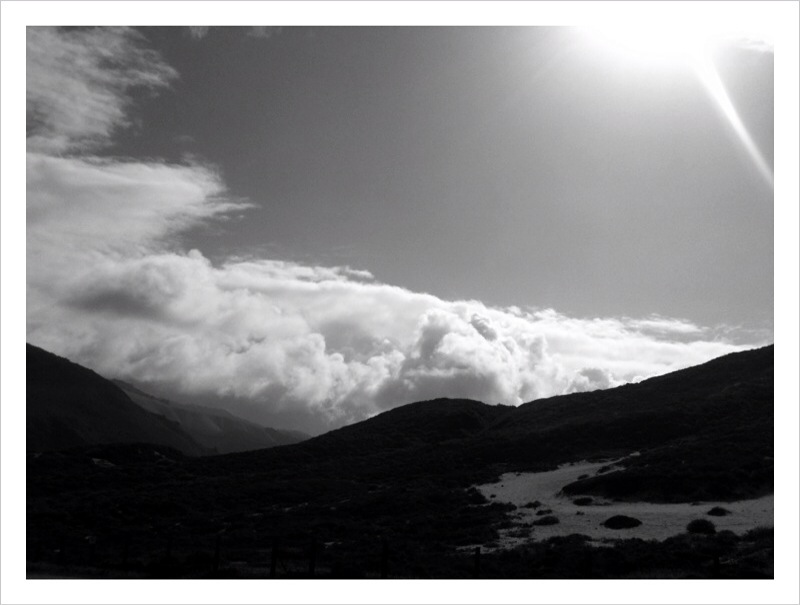
Being alone means you are established firmly in the here and the now and you become aware of what is happening in the present moment. You use your mindfulness to become aware of every feeling, every perception you have.
You’re aware of what’s happening around you in the sangha, but you’re always with yourself, you don’t lose yourself. That’s the Buddha’s definition of the ideal practice of solitude: not to be caught in the past or carried away by the future, but always to be here, body and mind united, aware of what is happening in the present moment. That is real solitude.
– Thich Nhat Hanh